AI Engines Recommend Brands Without Explaining Why. Here Is What Pallix Shows You Instead.
Founder & Editor
A detailed look at how one platform tracks, explains and fixes brand visibility inside AI answers
Ask ChatGPT to recommend a moisturiser, an expense tool, or an SEO agency, and it will name three or four brands. It will not tell you why it picked those. For the brands not named, there is no ranking page to check, no position to track, and until recently, no way to find out what happened.
A category of tools has grown up to answer that question. Nearly all of them return a number — a visibility score, out of 100 — and leave the marketer to defend it in a meeting. Pallix, an AI visibility and citation intelligence platform, was built around a different premise: a number you cannot audit is a number you cannot act on.
What measurement has revealed so far
The case for measuring this carefully rests on findings that are not obvious from the outside.
Running 23 consumer brands through daily tracking produced an average visibility of 42.5 out of 100 — with the top brand at 69 and the weakest at 22, and no relationship between funding raised and where a brand landed. Well-resourced brands were routinely beaten by smaller ones.
Examining what engines cite when they answer explains why. Around 51.6% of citations went to competitors' own websites, compared with 5.8% for the brand being asked about. And the cited pages were almost never individual product pages — they were category pages, comparison articles, marketplace listings and list-shaped editorial, whether or not the brand's own product pages were indexed.
Neither finding is visible from a score alone. Both emerged from reading the source layer, which is why the platform is built around that rather than around the number.
Why AI visibility scores are hard to trust
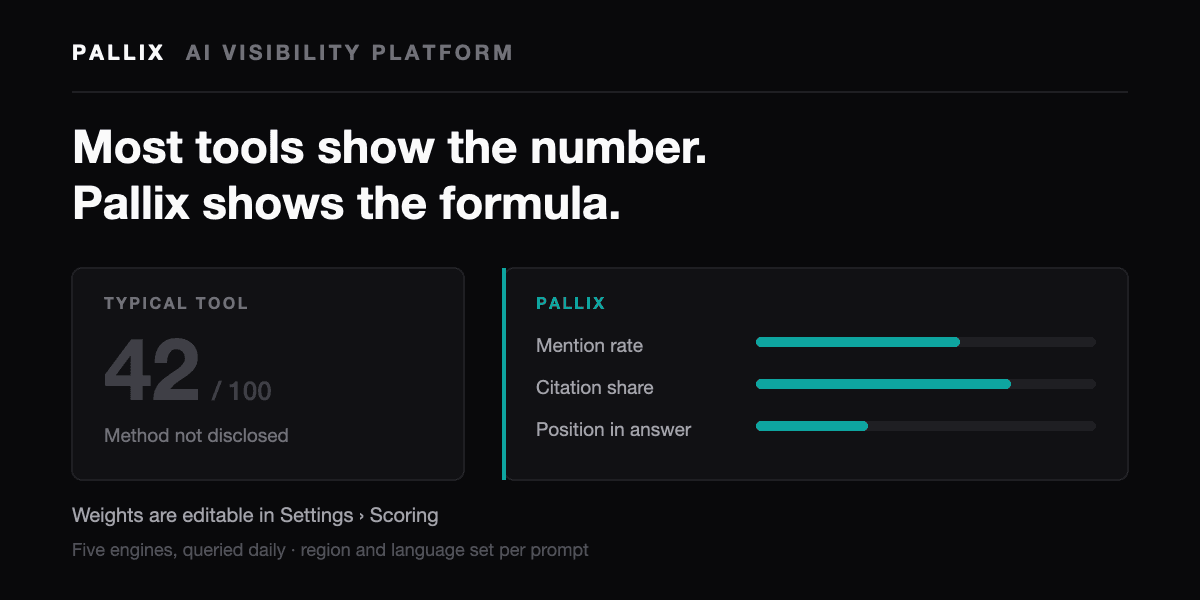
Every AI visibility score is a weighted formula. Someone decided that mention rate matters more than citation share, or that position inside the answer counts for a certain percentage. That decision shapes the number entirely — and in most tools it is invisible.
This is not an academic complaint. It is the first objection raised whenever a marketing team presents an AI visibility dashboard internally: where does this number come from, and why should we believe it?
Pallix exposes the formula. Its settings include a dedicated Scoring section governing which prompts count toward scores and how scores are calculated — and the weights are editable. A brand that cares more about being named than being linked can weight it that way. An agency reporting to a client with different priorities can set the formula to match those priorities, and show the client exactly what was set.
The same principle runs through the product. Where competitors report that a domain was cited, Pallix reports the URL, and the raw AI response it came from. Every prompt in the platform exposes the full answer text and the actual links cited — not a summarised domain list, but the pages a team has to go and change.
How Pallix tracks AI visibility across five engines
Pallix queries five engines — ChatGPT, Perplexity, Google AI Overviews, Gemini and Microsoft Copilot — on a daily cadence, with region and language configurable per prompt rather than per account. A single workspace can track a US market and an Indian one simultaneously, each queried on localised IPs for its own region, including code-mixed Hinglish where buyers use it.
The tracking layer covers:
- Visibility score with its editable formula, plus mention rate, citation rate and share of voice
- Prompt-level triage — which prompts are highest priority, which are at risk, which are stable, and how many days each has been observed
- Competitor share of voice, benchmarked prompt by prompt
- Sentiment, broken down by aspect rather than reported as a single positive/negative figure
- Hallucination detection, flagging where engines state incorrect facts about a brand
The aspect-level sentiment matters more than it sounds. A brand with poor AI visibility usually has one specific attribute dragging it down — pricing perception, ingredient concerns, delivery reliability, support quality. A single sentiment number hides that. Aspect breakdown names it, which turns sentiment from a vanity metric into a work instruction.
Citation intelligence: which sources AI engines actually read
This is where Pallix diverges most sharply from the category. Most tools tell a brand where it stands. Pallix reads what the engines read.
Citation intelligence shows every source cited across every tracked answer, with the pages ranked by how often they appear, and — critically — whether the brand is present on them. A domain cited two hundred times that never mentions your brand is a different problem from one that mentions you occasionally, and the platform separates the two.
Source gaps turns that into a target list: the specific pages that decide answers in a category, which competitors appear on them, and which of them omit the brand entirely. It distinguishes between pages a brand could realistically join, pages that are ageing and open to a refresh, and community threads where a stronger answer could displace a weaker one.
AI sourcing tracks the trend — what types of sources the engines are favouring over time. This shifts. A category dominated by marketplace listings one quarter can tilt toward editorial or community content the next. A brand optimising against last quarter's pattern is optimising against the past, and the only way to avoid that is to watch the composition change.
Market intelligence is the layer with the least direct equivalent elsewhere. It tracks what real people say about a brand and its category across social platforms, marketplaces and editorial sites, with the actual YouTube, Reddit and marketplace links attached rather than aggregate sentiment. It surfaces buyer pain points, competitor comparisons people make unprompted, and the language customers actually use.
That data does something structural: it builds the prompt set. Rather than guessing which questions to track, Pallix derives them from what people demonstrably ask about a category. The prompts being monitored are the prompts likely to be typed.
Reddit analysis and technical readiness complete the picture — the former because community threads are disproportionately cited by AI engines, the latter because crawlability, rendering and structured data determine whether a page can be retrieved at all.
From diagnosis to fixes: turning citation gaps into content
Most platforms in this category stop at diagnosis. Independent reviews of the major tools note this repeatedly.
Pallix's fix engine generates content briefs, FAQ blocks and posts derived from a brand's own citation gaps — the specific pages where competitors appear and the brand does not, the specific questions where sentiment is weakest, the specific sources trending upward in that category. Not a generic AEO playbook, which every vendor publishes and which by definition cannot know what any individual brand is missing.
Each tracked prompt also carries its own plan: what would have to be true for that prompt to name the brand.
AI traffic attribution: finding visits GA4 records as Direct
AI-referred visits frequently arrive without a referrer and land in analytics as Direct. Marketing teams see traffic they cannot attribute and AI channels that appear to send nothing.
Pallix's AI traffic decoder identifies these visits server-side and attributes them correctly, giving teams a second, independent measurement channel alongside citation counts.
Competitor tracking without a cap
Most tools ask a brand to name three to five competitors — a cap that forces guessing before the data exists. Pallix runs a discovery pipeline instead, surfacing candidate competitors from the answers and sources it observes and presenting them for review. In an active workspace, that queue can run to over a thousand entities awaiting review. A brand accepts the ones that matter and rejects the rest, but it starts from evidence rather than assumption.
Pallix pricing and free AI visibility audit
Plans start at ₹2,249 per month, with Growth at ₹5,399 and custom agency and enterprise arrangements above that. A 14-day Growth trial requires no card and no sales call, and a free audit runs without any signup at all.
Pricing is set in rupees for the Indian market — a small detail with a real consequence, since dollar pricing on a monthly SaaS subscription carries currency risk that Indian finance teams have to absorb.
Why transparency matters more in AI search than in SEO
Search rankings were verifiable. Anyone could type the query and see position seven. AI answers are not: they vary by user, by region, by phrasing and by day.
That unverifiability is exactly why the measurement layer needs to be transparent. When a brand cannot check the result themselves, the tool's method becomes the only thing standing behind the number — and a method that cannot be inspected is a method that has to be taken on faith.
Pallix's position is that no marketer should have to.
Frequently asked questions
What is an AI visibility platform?
An AI visibility platform measures how often a brand is named and cited in answers from AI engines such as ChatGPT, Perplexity, Google AI Overviews, Gemini and Copilot. It tracks which prompts surface the brand, which sources the engines cite, and where competitors appear instead.
How is an AI visibility score calculated?
It is a weighted formula, usually combining mention rate, citation share and position within the answer. The weights are chosen by the vendor and, in most tools, are not disclosed. Pallix exposes its formula in settings and allows the weights to be edited, so a brand or agency can align the metric with its own priorities.
Which AI engines can be tracked?
Pallix tracks five: ChatGPT, Perplexity, Google AI Overviews, Gemini and Microsoft Copilot, queried daily with region and language configurable per prompt.
Can AI visibility tools tell you how to fix low visibility?
Most only report it. Pallix generates content briefs, FAQ blocks and posts from a brand's own citation gaps, and attaches a plan to each tracked prompt describing what would need to change for that prompt to name the brand.
Why does AI-referred traffic show up as Direct in analytics?
AI engines frequently send visits without a referrer, so analytics tools record them as Direct. Pallix's AI traffic decoder identifies these server-side and attributes them to the originating engine.
How much does Pallix cost?
Plans start at ₹2,249 per month, with Growth at ₹5,399 and custom agency and enterprise arrangements above that. A 14-day Growth trial requires no card, and a free audit runs without signup.
Pallix is an AI visibility platform for brands. It is available at pallix.in.