ChatGPT has started telling buyers which brands to avoid
Contributor
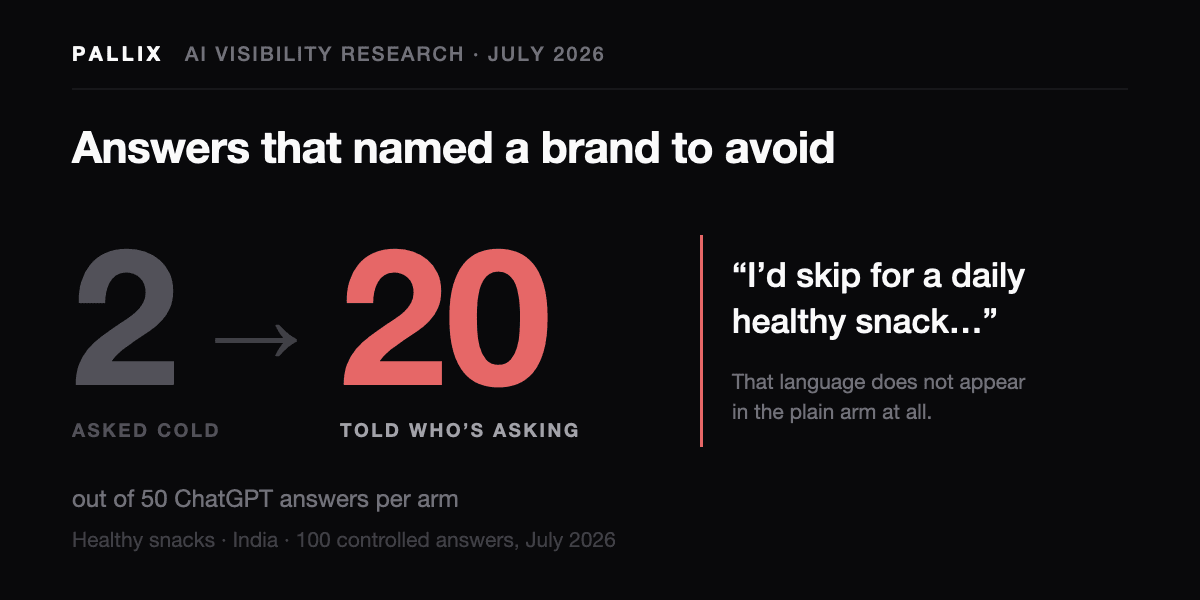
Tell it who is asking, and the answer stops being a shortlist and becomes a shortlist plus a blacklist.
Every AI-visibility tool measures the same thing: was your brand mentioned.
That metric is now missing half the picture. We ran 100 controlled ChatGPT answers in India and found the model doesn’t just rank brands any more. It names some of them so the reader won’t buy them.
The setup
Five healthy-snack questions, ten runs each, from an Indian IP in a fresh incognito window. Then the same fifty runs again — except this time we told ChatGPT who was asking first:
I’m a 27-year-old software engineer in Bangalore… currently in a cutting phase. I weigh my food and track macros every day, so I read labels closely. What I care about most is protein per 100 calories, added sugar, and how short the ingredient list is. Price isn’t really a constraint.
Then we recorded, for every answer, not just which brands appeared but whether each was named as something to buy or something to skip.
The number
Plain answers containing a de-recommendation: 2 of 50.
Persona answers: 20 of 50.
By individual brand warnings rather than by answer, it’s 4 versus 38. Ask cold, you get a list. Say you’re cutting and you read labels, and you get this:
I’d skip for a daily healthy snack
Many MuscleBlaze bars: plenty of protein, but several varieties use multiple sugar syrups and more processed ingredients.
Standard RiteBite Max Protein bars: convenient, but ingredient lists tend to be longer and more processed than cleaner-label options.
That language does not appear in the plain arm at all.
Ten brands are recommended and rejected at the same time
Of 29 brands, 10 were contested — recommended in some answers, warned against in others, usually because one product line got praised while another got flagged.
RiteBite: recommended 19 times, warned against 5. Yogabar: 18 and 5. MuscleBlaze: 13 and 7. One brand, Lay’s, was named in 5 answers and never once as a recommendation.

Here’s why that matters. Our own first pass counted mentions, and it reported RiteBite gaining under the persona — 12 up to 19. Reading the answers showed five of those were ChatGPT telling the buyer to skip it. A mention-based tool doesn’t just miss a warning. It books it as a win.
Every warning belongs to one question
No brand is warned against across the board:
| Brand | Warnings | Where |
|---|---|---|
| MuscleBlaze | 7 | protein bar ×3, low-sugar bar ×4 |
| Raw Pressery | 6 | RTD shake ×6 |
| Lay’s | 5 | healthy chips ×5 |
| RiteBite | 5 | protein bar ×3, low-sugar bar ×2 |
| Horlicks | 3 | RTD shake ×3 |
Raw Pressery and Lay’s each lose on exactly one question. That’s not a brand-perception problem — it’s one answer to go and win.
And the objection barely varies. MuscleBlaze and RiteBite get dinged for the same thing every time — ingredient-list length and sugar syrups — usually measured out loud against a named competitor: “ingredient list is less ‘clean’ than The Whole Truth.” That’s a specific, checkable claim about a formulation, delivered at the moment of decision, repeatedly.
Why it started doing this
The persona changed what ChatGPT reads. 1mg.com went from 0 citations to 28. yogabars.in from 0 to 13. BigBasket 0 to 9. Meanwhile Good Housekeeping went 17 to 0, Healthline 16 to 3, EatingWell 10 to 0.

Those Indian commerce and brand-owned pages are where nutrition panels and full ingredient lists live. Feed the model label-level data and it starts making label-level judgements. The de-recommendations aren’t a personality change — they’re what happens when it finally has the numbers to compare.
What to do about it
- Measure de-recommendation, not just mention. A brand named as a thing to avoid isn’t visible, it’s losing in public.
- Attach every warning to a question. “Warned against 6 times” is a mood. “6 times, all on the RTD shake question, all for ingredient list” is a work item with an owner.
- Read the objection and decide if it’s true. If it’s accurate, that’s a product decision. If it’s out of date, you now know exactly which page has to say otherwise — and which sources ChatGPT will read it from.
Method and limits
100 answers: 5 prompts × 10 replicates × 2 arms, ChatGPT only, collected 31 July 2026, run from an Indian IP in a fresh incognito window each time — no account, no chat history, no personalisation carried between runs. The persona is turn one, the tracked question turn two of the same session; we verified turn one named no brands and triggered no product search, so turn two is a clean measurement.
Brand detection used a 67-name vocabulary built from the captured answers themselves, so a brand ChatGPT never named can’t appear. Recommendation versus warning was assigned by which section of the answer a mention fell in, and hand-checked.
Two limits. This is one engine and one persona — a different buyer profile would likely produce a different rejection list, and we haven’t tested that. And individual brands’ recommendation-rate changes do not survive statistical correction at this sample size, so we treat those as descriptive. The warning behaviour itself — 2 answers versus 20 — is large enough that it doesn’t depend on that caveat.
If you sell a snack in India, someone is being told to skip it right now, by name, for a reason you can go and read.