Why AI recommends your competitor: how five assistants actually decide what to cite
Founder & Editor
Ask five AI assistants the same buying question, say "best sunscreen for oily skin," "wireless earbuds under ₹3,000," or "which course consultant for studying abroad," and you'll often get five different sets of brands, assembled from five different sets of sources. To a marketer that looks random. It isn't. Each assistant runs a different machine underneath, with a different idea of where trustworthy answers live.
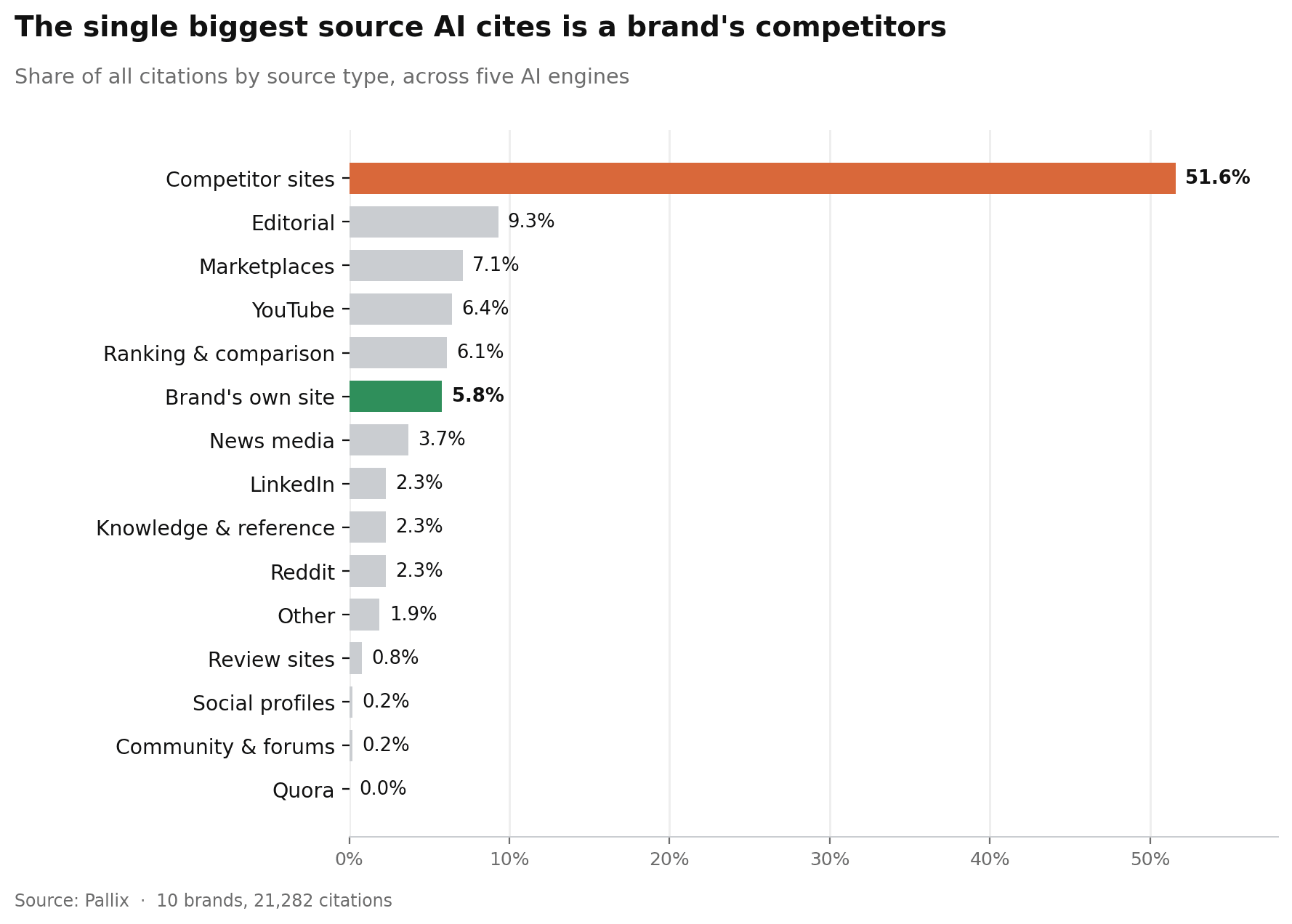
We traced 21,282 citations across ChatGPT, Perplexity, Gemini, Google AI Overviews and Copilot for the same set of brands. The headline finding is uncomfortable and consistent: when AI describes a brand, it mostly reads that brand's competitors' pages. Competitor sites were the single largest source of citations overall, at 51.6%, and the number-one source in four of the five engines. A brand's own website accounted for just 5.8%. This piece explains why, engine by engine, and what to do about it.
First, the shift: ranking is out, retrieval is in
Traditional search ranks a list of links and you click one. An assistant does something different: it retrieves a set of candidate pages, reads them, and writes a single answer, citing only a few. That creates two gates. The first is retrieval: is your page even pulled into the candidate pool? The second is absorption: does your page actually shape the answer, and does your brand get named in it?
Most brands that "show up as a source somewhere" still lose, because a competitor's page shapes the actual recommendation. This is the mention-source divide: your rival gets named in the answer, while the citation link points to a review site, a marketplace, or a forum. Our data makes it concrete. Across engines, the pages doing the describing overwhelmingly belong to competitors, not the brand.

ChatGPT: it lives on brand-owned sites, mostly your rivals'
ChatGPT runs in two modes. In its default mode it answers from what it learned in training, without fetching live pages; when it browses, it searches the web, weighs domain authority, clarity and recency, and returns a handful of citations. Across both, it largely ignores user-generated content, and forums, Reddit and Quora were effectively 0% of what it cited.
The result: about 93% of ChatGPT's citations came from brand-owned websites, but 59% were competitors' sites and only 34% the brand's own. Marketplaces, video and community barely registered. The practical read: on ChatGPT your battle is fought entirely on owned domains, and right now your competitors' domains are winning it three-to-two. If your site answers the buyer's question more cleanly than theirs, you flip that; if it's brand-voice fluff, ChatGPT reaches for a rival's page.
Perplexity: the most diverse, and it barely touches your site
Perplexity runs a retrieval-augmented pipeline: it breaks a question into sub-queries, pulls a candidate pool, reranks, and cites only a few, always with visible links and always weighting freshness. It cited the most of any engine in our study (more than half of all 21,282 citations), and it spreads widest: competitor sites 48%, editorial 10%, ranking-and-comparison pages 8%, YouTube 7%, marketplaces 5%, and the brand's own site just 5%.
Two consequences follow. First, if you block Perplexity's crawler in robots.txt you're excluded from its citation pool entirely, a self-inflicted blind spot. Second, this is where the competitor-citation problem bites hardest: Perplexity would rather cite someone describing you than you describing yourself, so whoever owns the best third-party explanation of your category tends to win the mention.
Gemini: the one engine that reads your own site
Gemini is the outlier. 73% of its citations came from the brand's own website, with competitors a distant second. It leans on Google's own retrieval and clearly trusts first-party domains far more than the others do. One caveat: this pattern sat on a much smaller citation base than the other engines, so treat the exact figure as directional rather than settled. The strategic point still stands: Gemini is the engine where a strong, answerable owned site pays off most directly.
Google AI Overviews: the widest net, into video and marketplaces
AI Overviews is powered by Gemini but sits on top of Google's live index, running a "fan-out" of several related searches and stitching passages together at the top of the results page. It cast the widest net in our data: competitor sites 55%, then YouTube 9%, marketplaces 8% and the brand's own site 8%, with a long tail into news, reference and community. If your brand lives only on a polished website with no video or marketplace footprint, you're optimising for a sliver of this engine.
Copilot: comparison and editorial pages win here
Microsoft's Copilot is Bing-native: it turns your question into internal grounding queries, fires them at Bing's index, and cites the top results. After competitor sites (47%), its biggest sources were ranking-and-comparison pages (14%) and editorial (13%); marketplaces were only 7%. The practical read: Copilot rewards the "best X for Y" and "X vs Y" pages, and it can only see you if Bing has indexed you. Usefully, Bing Webmaster Tools reports which of your pages Copilot cites, making it the one engine that shows its working.
Why the same brand gets five different answers
Line the engines up and the logic is clear. ChatGPT fights on owned domains. Perplexity rewards third-party editorial, comparison and video. Gemini trusts the brand's own site. AI Overviews reaches into video and marketplaces. Copilot rewards comparison and editorial pages. A brand strong on its own site but thin on comparison content wins Gemini and loses Copilot. A brand with great marketplace listings but a weak blog is invisible to ChatGPT. One "AI strategy" covers, at best, one engine.
And beneath all of them sits the same structural fact: for a non-branded category question, the engine looks for the page that answers it best, regardless of whose brand owns it. Whoever owns the clearest explanation gets cited, and their brand rides along in the recommendation. That is why competitor sites dominate, and why content that genuinely teaches ("how to choose X") is now a land-grab for the exact high-intent queries where buyers are still deciding.
This is a moving target: track it, don't set-and-forget
Every number above is a snapshot, and the picture moves. Across these brands, the last 30 days saw AI lean noticeably more on editorial (up 3.5 points) and markedly less on Reddit (down 3.6 points), with competitor sites still climbing (up 2.7). Narrow the window to seven days and the movers reshuffle, with competitor sites up and marketplaces down. Same brands, same engines, a different fortnight, a different blend.

Two things follow. First, there is no fixed number to optimise to: the source mix drifts month to month, differs by category and by engine, and any single audit has a short shelf life. Second, and more useful, the drift itself is the signal. Where an engine's attention is moving toward is where fresh content is most likely to earn new citations. If editorial is rising for your category this month, an editorial push compounds; if Reddit is cooling, the same effort buys less. The job isn't to find the right sources once and publish accordingly. It's to keep watching which sources each engine is warming to for your category, and to point your content strategy, what you publish and crucially where you seed it, at that drift as it happens.
What to actually do, engine by engine
For ChatGPT and Gemini, make owned content answerable, not just on-brand: comparisons, honest specifics, "how to choose" pages, clear headings, the answer in the first hundred words, current timestamps. This is where you beat competitor domains on their own turf.
For Perplexity, earn third-party coverage (reviews, editorial, comparison pages), confirm you aren't blocking its crawler, and keep content fresh.
For Copilot, fix Bing first (verify in Bing Webmaster Tools, use IndexNow), then invest in comparison and editorial pages, which is what it actually cites.
For AI Overviews, rank and build a genuine video and marketplace footprint, plus community discussion in your category, with structured data so the engine can parse you.
Across all of them, watch your competitors' citations, not just their rankings. If assistants keep answering your category with a rival's page, that is the gap to close, and it is almost always a content gap, not a media-spend one.
The shift underneath all of this is easy to state and hard to act on: brand discovery is moving from ranking to being cited. And because the blend keeps moving, being cited is not a milestone you reach once; it's a position you hold by watching the drift and adjusting. The brands that show up in AI answers over the next year won't be the ones spending the most. They'll be the ones who keep learning which sources each engine is warming to, and keep putting their content there.
Pallix builds this map for brands: which engine cites what, for your category, so you know exactly which gap to close first. See how your brand appears across the five engines at app.pallix.in.