AI Engines Are Answering Indian Buyers With American Sources. Indian Brands Are Paying For It.
Founder & Editor
Why measuring AI visibility from outside the market produces the wrong answer — and what the data shows about Indian brands' standing inside AI results
An Indian shopper asks ChatGPT which sunscreen to buy. A procurement manager in Pune asks Gemini to compare expense tools. A parent in Coimbatore asks Perplexity about protein supplements for a teenager.
Each of them gets an answer assembled from whatever sources the engine retrieved at that moment. Those sources are not fixed. They depend on where the question came from, what language it was asked in, and which pages the engine could reach.
Which raises a question most Indian brands have not yet asked: when a measurement tool reports your AI visibility, whose answer is it reporting?
Why query origin changes the AI answer
Most AI visibility platforms are built in the United States and query from their own infrastructure. Some offer a region setting — a locale flag applied to a query that still originates elsewhere.
That is not the same thing as asking from inside the market. An engine responding to a genuine query from an Indian IP, in the language an Indian buyer would use, can and does return different sources: Indian marketplaces, Indian editorial titles, Indian community threads, Indian pricing. The same principle holds anywhere — a US brand needs US-origin queries, a UK brand needs UK-origin ones — which is why localised IPs per region, rather than a locale label, is the underlying requirement. India simply makes the gap most visible, because the default origin for almost every tool in this category is somewhere else.
A brand measuring itself through a US-origin query is measuring a market it does not sell to. It may look healthy in a dashboard and be invisible to the buyer it actually wants.
The gap widens further with language. A substantial share of Indian commercial queries are not clean English. They are code-mixed — Hinglish, or English with Hindi grammar and transliterated terms. "Indian D2C brands ke konse AI visibility tools compare karun?" is a real query shape, not a novelty, and a tool that cannot issue it cannot measure it.
AI visibility study: 23 Indian health and nutrition brands
Pallix, an AI visibility platform built for per-market measurement, ran a study across 23 Indian health and nutrition brands, tracking how often each was named across major AI engines.
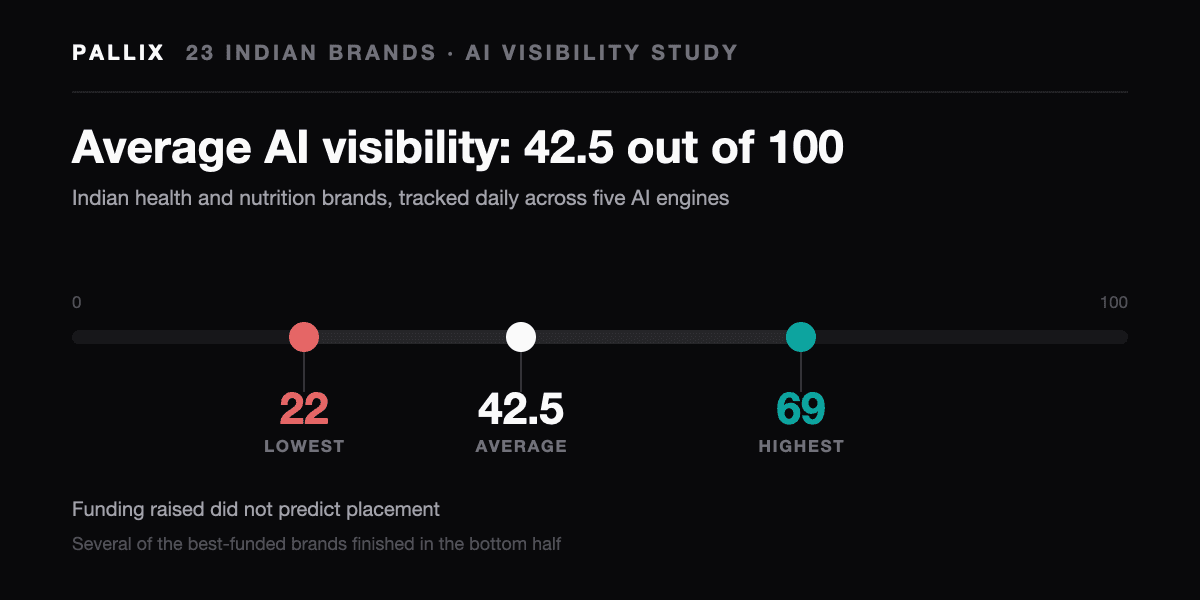
The average visibility score was 42.5 out of 100. The strongest performer, SuperYou, reached 69. The weakest, Open Secret, sat at 22.
The most useful finding was what did not predict the score. Funding did not. Several of the best-funded brands in the set placed in the bottom half, while smaller brands with narrower catalogues outperformed them. Whatever determines AI visibility, it is not marketing budget.
A separate analysis of AI-generated answers across Indian categories found a sharper pattern still. When engines cited sources, 51.6% of citations went to competitors' own websites, against 5.8% for the brand being asked about. Put plainly: when an AI describes your brand, it is usually reading your competitor's page.
A third finding, consistent across categories: the pages that get cited are almost never individual product pages. They are category pages, comparison articles, marketplace listings and list-shaped editorial. A brand can have every product page indexed and still be absent from every answer, because the engine is not reading product pages to build a recommendation.
Which sources AI engines cite for Indian queries
Analysis of which sources AI engines cite for Indian commercial queries shows a distinct composition from Western equivalents.
For consumer products, the enumeration layer is marketplaces — Amazon, Flipkart, HealthKart, Nutrabay, Nykaa, Blinkit, Myntra — supplemented by YouTube reviews and category-specific Indian blogs. For services, it is directories and regional listicles: pages titled "Top 5 X in India" carry disproportionate weight. For technical and regulated categories, it is Indian trade press — the health, pharma and industry titles — often articles eighteen months old that nothing newer has displaced.
None of those source sets appear reliably in a US-origin query. A brand optimising against a Western citation profile is optimising for the wrong shelf.
Why publishing more content usually fails in India
The instinct on discovering low AI visibility is to publish more content. The data suggests that is usually the wrong first move.
If the pages deciding a category's answers are marketplace listings and third-party comparisons, then a brand's own blog output — however good — is not what the engine is reading. The determining factor is presence on the sources the engine already trusts in that market.
Establishing which sources those are requires querying from inside the market. Which is where the measurement layer and the strategy layer collapse into the same problem.
How per-market AI visibility tracking works
Pallix queries five engines — ChatGPT, Perplexity, Google AI Overviews, Gemini and Copilot — on localised IPs, with region and language set per prompt rather than per account. An Indian D2C brand and a US software brand can run in the same workspace, each measured against its own market, and a brand selling into several states or several countries can carry all of them side by side.
Prompts built from what Indian buyers actually ask. The platform's market intelligence layer reads Indian marketplace reviews, YouTube comments, Reddit and regional community discussion to establish what people in a category genuinely want to know — the concerns they raise unprompted, the comparisons they make, the words they use. Those questions become the tracked prompt set, including code-mixed phrasing. This matters more in India than elsewhere: a prompt list written in a boardroom in clean English will miss the way a large share of Indian buyers actually type.
The source layer, read directly. Rather than reporting that a brand ranks poorly, the platform reports which pages the engines read to build each answer — the specific URLs, not just domains — and whether the brand appears on them. For Indian categories that usually means Amazon, Flipkart, HealthKart, Nykaa, Blinkit and Myntra listings, YouTube reviews, Indian trade titles and community threads. A source-gap view then separates the pages a brand could realistically join, the ageing articles open to a refresh pitch, and the threads where a better answer could displace a weaker one.
Which way the sources are moving. Source composition in a category shifts quarter to quarter — marketplace-heavy one period, editorial or community-heavy the next. The platform tracks that drift, so a brand is not building against last quarter's pattern.
Sentiment broken down by aspect. A single sentiment figure tells an Indian brand that perception is mixed. Aspect-level breakdown identifies which attribute is responsible — price positioning, ingredient concerns, delivery reliability, after-sales support — which is the difference between a metric and a to-do list. The platform also flags hallucinations, where an engine states something about a brand that is simply untrue.
Fixes derived from the brand's own gaps. Content briefs, FAQ blocks and posts are generated from that brand's specific citation gaps rather than a generic AEO playbook, and each tracked prompt carries a plan describing what would have to change for that prompt to name the brand.
Competitors discovered, not declared. Most tools ask for three to five competitor names up front. Pallix surfaces candidates from the answers and sources it observes — in Indian categories, frequently including regional players a brand had not been watching — and presents them for review.
Traffic that analytics loses. AI-referred visits often arrive without a referrer and are recorded as Direct. A server-side decoder identifies and attributes them, which matters for Indian teams defending budget for a channel that otherwise appears to send nothing.
A score you can inspect. The visibility score's formula is exposed in settings with editable weights, so a brand can align the metric with what its own leadership cares about rather than accepting a vendor's judgement.
Technical readiness checks and rupee-denominated pricing complete the picture. Plans start at ₹2,249 per month and ₹5,399 for Growth, with a 14-day trial that needs no card and a free audit that requires no signup at all — and pricing in rupees means Indian finance teams are not absorbing currency risk on a monthly subscription.
What Indian D2C brands should do next
India's D2C sector has spent a decade learning search and paid social. Both were measurable: a brand could check its own ranking, read its own cost per acquisition, and verify the number independently.
AI answers offer no such check. They vary by person, by phrasing, by region and by day. A brand cannot type the query and confirm what its customers see — because what its customers see depends on where they are asking from.
That makes the choice of measurement infrastructure unusually consequential. A tool that queries from outside India will produce a confident number about a market that does not exist.
The brands that work this out early will spend the next two years building presence on the sources their buyers' AI answers are actually assembled from. The ones that do not will optimise, carefully and expensively, for an audience in another country.
Frequently asked questions
What is AI visibility, and why does it matter for Indian brands?
AI visibility is how often a brand is named and cited in answers from ChatGPT, Perplexity, Google AI Overviews, Gemini and Copilot. It matters in India because AI answers to Indian buyers are assembled from Indian marketplaces, Indian editorial and Indian community threads — sources that a query originating outside India may never surface.
Does funding predict AI visibility?
No. Across 23 Indian health and nutrition brands, average visibility was 42.5 out of 100, and several of the best-funded brands placed in the bottom half. Smaller brands with narrower catalogues frequently outperformed them.
Why do AI engines cite competitors instead of the brand being asked about?
Analysis of Indian category answers found 51.6% of citations went to competitors' own websites against 5.8% for the brand in question. Engines assemble answers from whichever pages enumerate the category — comparison articles, marketplace listings and category pages — and a brand absent from those pages cannot be named.
Do AI engines read product pages?
Rarely. Across categories, the pages cited are consistently category pages, comparison articles, marketplace listings and list-shaped editorial — not individual product pages, regardless of whether those product pages are indexed.
Does Hinglish matter for AI search in India?
Yes. A significant share of Indian commercial queries are code-mixed rather than clean English. A measurement tool that cannot issue code-mixed prompts cannot measure how a brand performs on them.
How can an Indian brand check its AI visibility?
Pallix offers a free AI visibility audit with no signup, querying on localised IPs for the Indian market. Paid plans start at ₹2,249 per month.
Pallix is an AI visibility platform for Indian brands, built for per-market measurement. More at pallix.in.