What is Pallix? The AI visibility platform built for Indian brands
Founder & Editor · Updated July 15, 2026
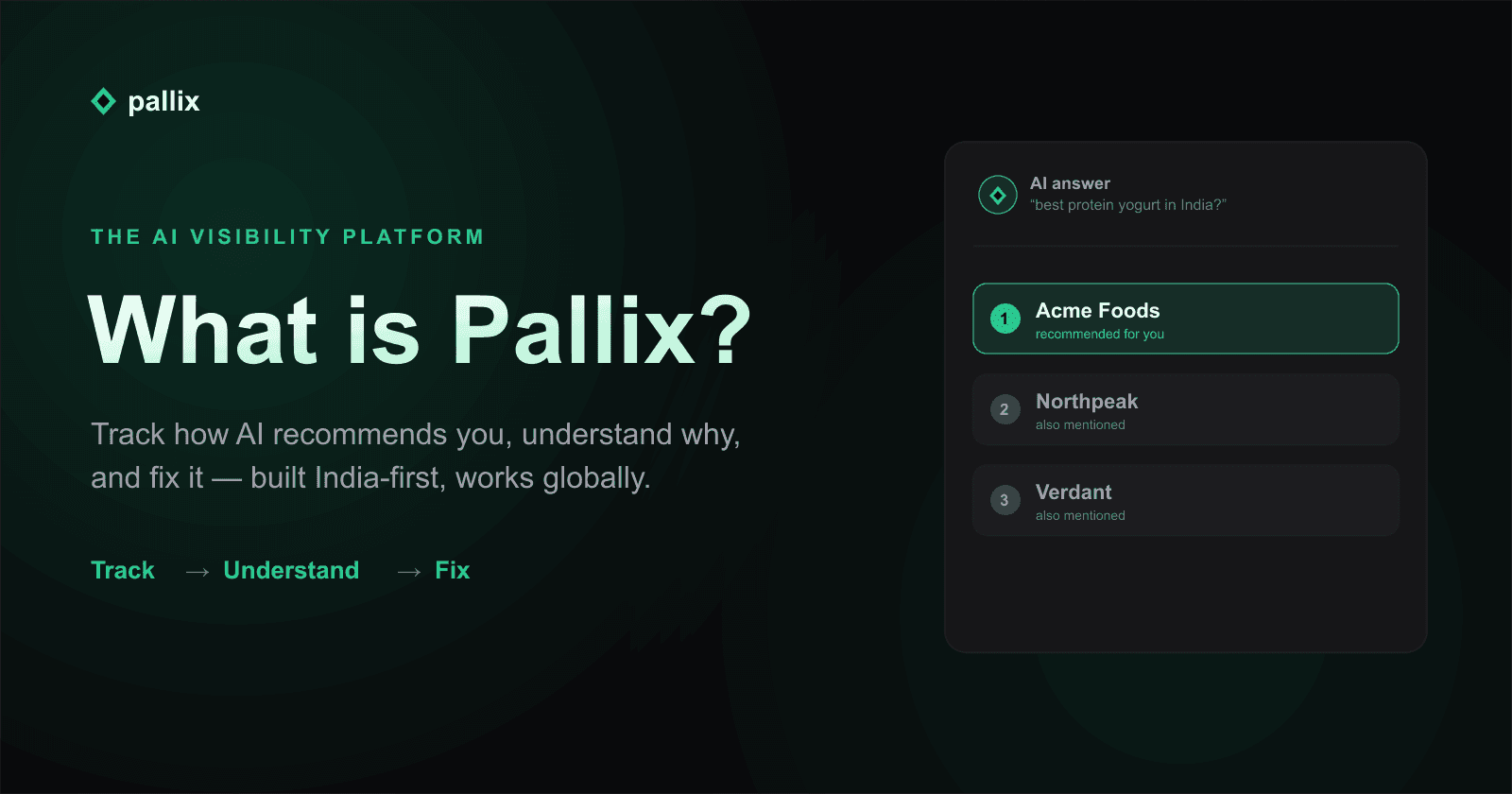
Your next customer may never visit your website before deciding what to buy. They open ChatGPT, Perplexity or Google's AI Overviews, ask "which is the best protein yogurt in India?" and get back a confident shortlist of three or four brands. If yours is on it, you're in the running. If it isn't, you were never in the conversation — and unlike a slipped Google ranking, there's no impression to track and no click to miss. You simply don't appear, and you have no way of knowing it happened.
Pallix exists to make that invisible shelf visible. It is an AI visibility platform built India-first — designed around how Indian buyers actually search, though the audit and dashboard now work for brands in any market. But "visibility tool" undersells it. Plenty of tools can hand you a score. Pallix is built to answer the three questions a score can't: are you being recommended, why or why not, and what exactly should you do about it. This guide explains what each part of the product is for — the decision it helps you make and the value you walk away with.
The shift Pallix is built for
For years, being discovered meant ranking on Google. That is no longer enough. People increasingly skip the list of blue links and ask an AI directly — and the AI returns one synthesised answer naming a handful of brands rather than ten pages of options. There is no "page two" in an AI answer. You are either named or you are not.
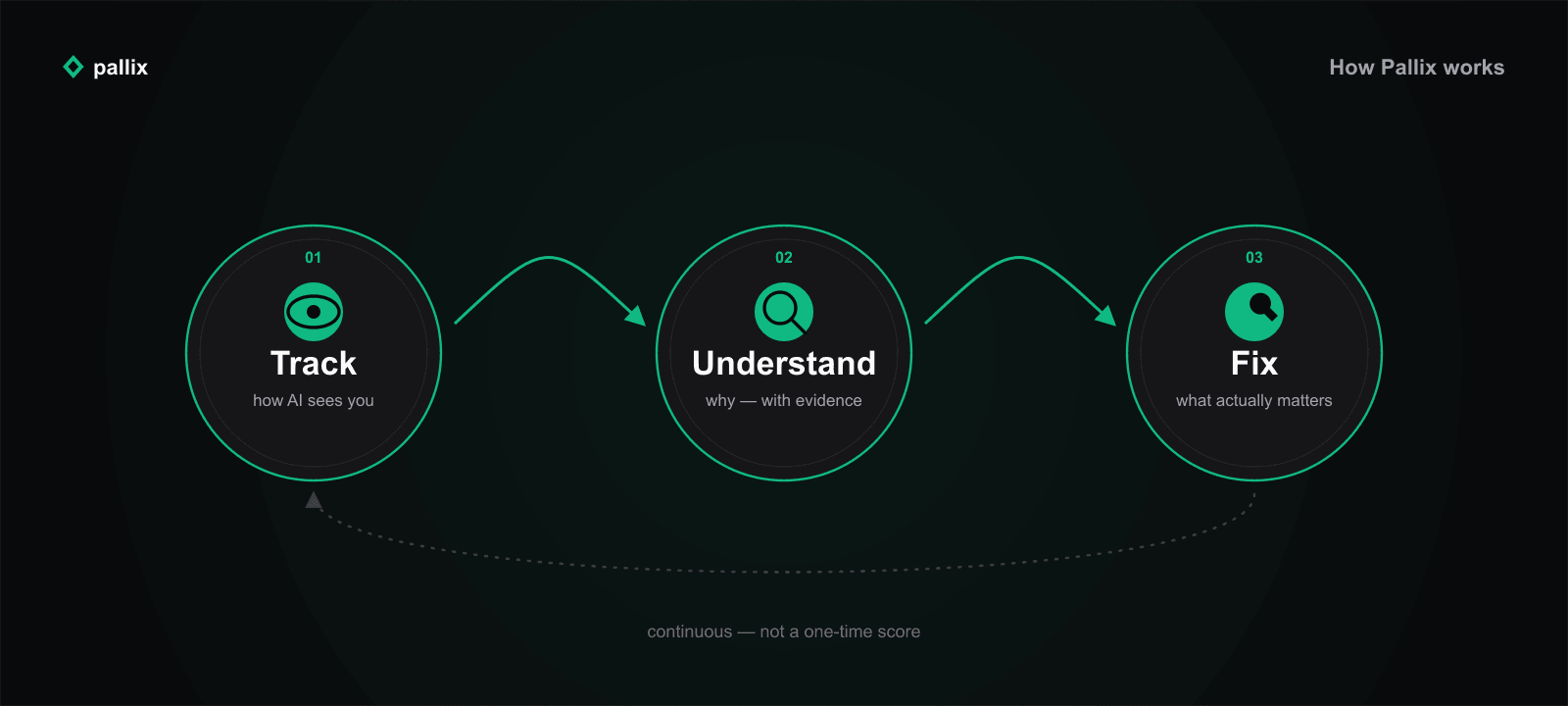
This is a different game with different rules. AI engines don't decide who to recommend based on your website alone. They lean on third-party proof — community discussions, marketplace listings, reviews, YouTube, editorial coverage — and on how clearly your own pages can be read and trusted. Traditional SEO tools were never built to measure any of this. Pallix was. Everything that follows is one connected system organised around a single loop: track how AI sees you, understand why, and fix it.
Overview: the one honest answer, and the one thing to do next
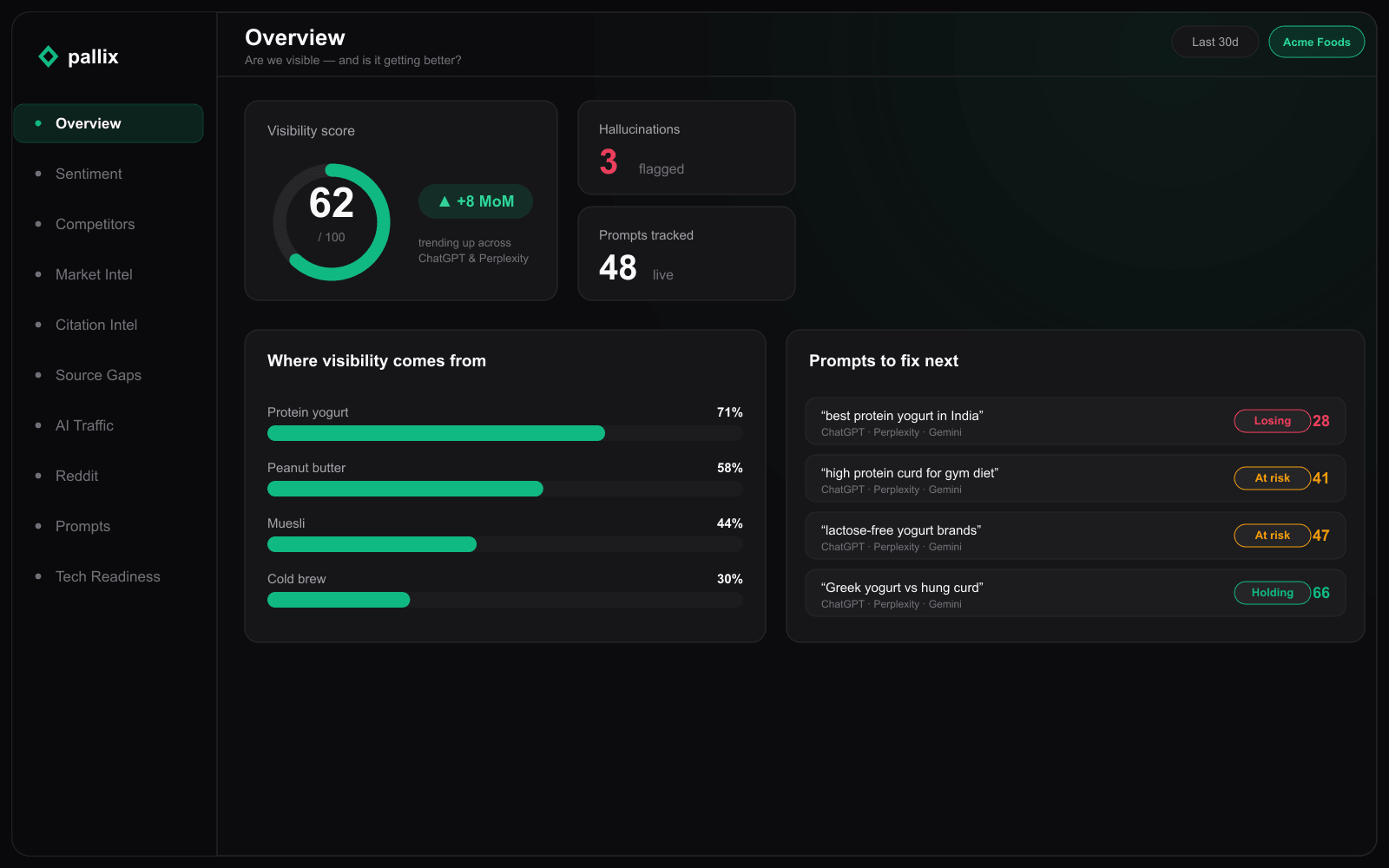
Most dashboards drown you in numbers. The intent of the Overview is the opposite — to give you, in a glance, the only two things that matter day to day: are we visible, and is it getting better or worse? A single visibility score with its trend answers the first. A breakdown of which product categories are actually winning you mentions answers where that visibility is coming from.
But the real value is that the Overview never leaves you staring at a number with no idea what to do. It surfaces the specific buyer questions where you're most invisible or most at risk, ranked so you always know the single highest-leverage thing to recover next — not "improve your visibility" but "this exact question, where you're losing, fix it first." And the moment you want the story behind any of them, the full picture is right there: what the AI actually said, which competitors it named instead of you, and which sources it built that answer from. It also quietly watches for a costlier problem — when AI states things about your brand that simply aren't true — because a confident wrong answer loses a sale just as surely as invisibility does.
Sentiment: being recommended well, not just recommended
Showing up in an AI answer is only half the battle. AI can name your brand while quietly framing it as overpriced, or sour-tasting, or unreliable — and that framing is often what decides whether the buyer actually picks you. The purpose of Pallix's sentiment work is to make that framing visible and, more importantly, explain what's driving it.
So instead of a vague "mostly positive," you get a clear read on the themes shaping how AI talks about you — pricing, trust, quality, availability, reliability — and how each is trending. The value is in the diagnosis: every theme is pinned to the real customer voice behind it, the actual complaint or piece of praise that created that impression. That tells you whether a weak spot is a genuine product issue, a thin review profile, or simply a story competitors are telling that you've never countered. Pallix also flags "framing tension" — when AI describes you in contradictory ways, calling you both budget and premium — because a muddled story is its own kind of invisibility. You see what's hurting you and what's working, always with the evidence attached.
Competitors: when AI doesn't pick you, who gets the sale
Every time AI recommends someone else, that's a customer who never reached you — and they reached a named competitor instead. The intent of competitor intelligence is to turn that abstract loss into something you can actually fight back against.
Pallix shows how much of the category conversation you own versus your rivals, who is rising and who is fading, and — the part that makes it actionable — who wins where. Some competitors dominate on ChatGPT, others on Gemini; some own "best for breakfast" while others own "best value." Knowing this means you don't have to beat everyone everywhere. You can pick the specific battles you're positioned to win and ignore the ones you're not, which is the difference between a strategy and a wish.
Market Intel: the unfiltered voice of your market
AI doesn't form its opinion of your category in a vacuum — it's summarising thousands of real conversations happening on Reddit, marketplaces, YouTube and review sites. The intent of Market Intel is simple: you should be able to hear those conversations too, because they're both your most honest customer research and the raw material AI is learning from.
The value is unfiltered voice-of-customer at scale. Pallix lays out what buyers genuinely like and complain about — for your brand and for your competitors — what the category as a whole wants, evaluates and worries about, and any reputation risks surfaced in customers' own words. Because the same conversations feed the AI's recommendations, fixing what you find here doesn't just improve your reputation; it improves the very evidence base AI draws on to decide whether to recommend you.
Citation Intel: the levers that actually move citations
Getting cited by AI can feel like a black box, but it runs on identifiable signals — and the purpose of Citation Intel is to expose those levers so you can pull the right ones. It measures the things that decide whether you get cited: how consistently you appear in non-branded "best of" type questions, how often you're cited at all, how much of your citation footprint comes from your own pages versus earned editorial coverage.
Then it makes that concrete. It tells you which exact questions you own, which are contested, and which you're losing — so you know where your authority is real and where it's slipping. And it ranks your own pages by how much untapped upside each one has, with a specific reason for each: this product page needs stronger comparison framing, that one needs clearer proof and a FAQ structure so models have an obvious reason to cite it. "Be more citable" becomes a prioritised, page-by-page worklist.
Source Gaps: where to go to earn your way in
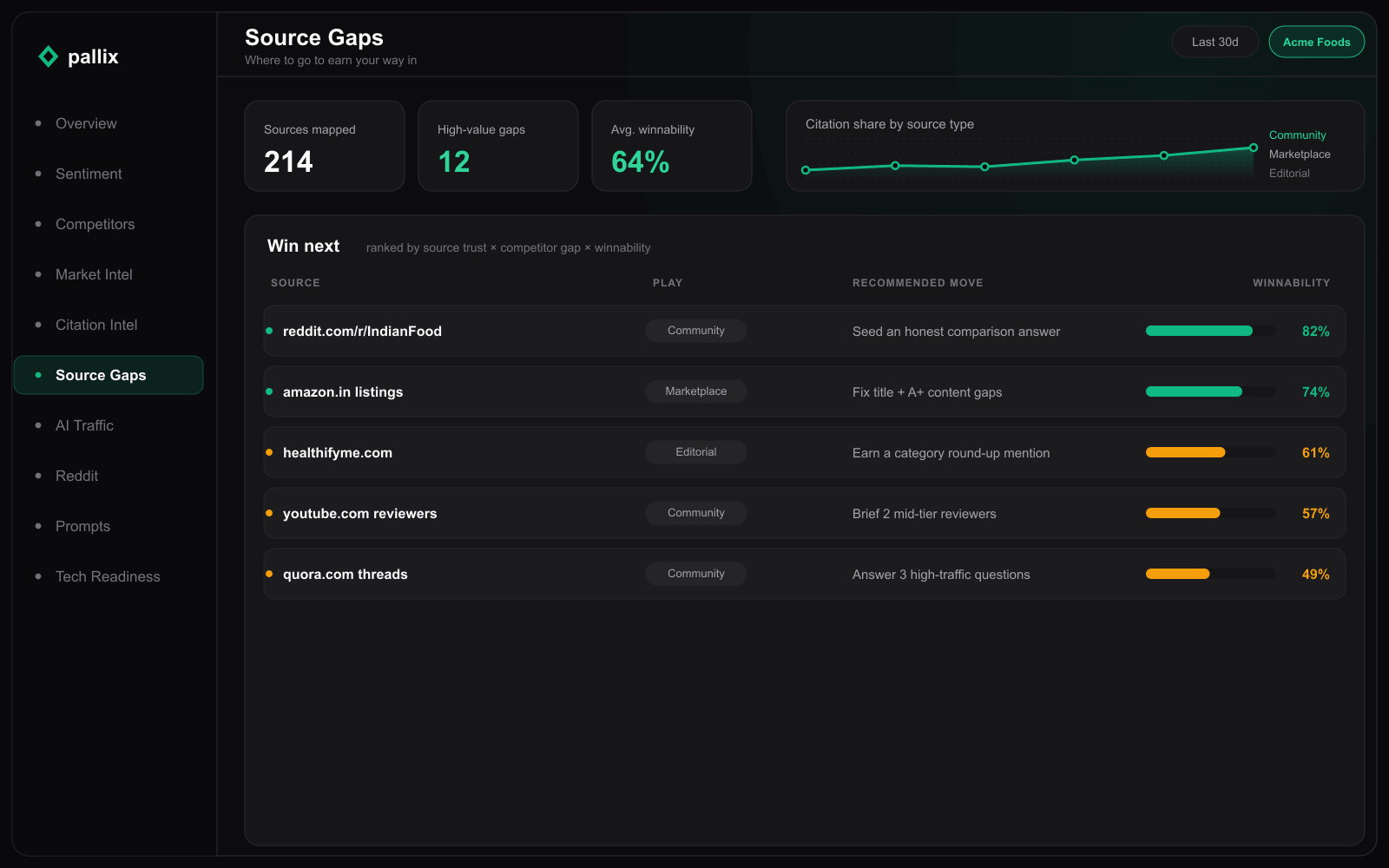
Knowing you're invisible is useless if you don't know where to go to fix it. This is the gap most tools leave you in — a diagnosis with no destination. Source Gaps exists to hand you the destination.
Pallix maps the places AI is drawing on for your category and ranks the highest-value ones to influence next — weighing how much AI trusts each source, how far ahead competitors already are there, and how winnable it realistically is. Each recommendation comes with the specific move that matters most, whether that's securing cleaner marketplace listings, seeding answers in a particular community, or earning a specific kind of coverage. The value is a prioritised outreach-and-content map: you spend your limited time on the few sources that will actually shift your standing, instead of guessing.
AI Traffic: counting the customers AI is already sending you
Here's a problem most brands don't even know they have: AI is already sending real people to your website, and your analytics is hiding it. Because AI assistants strip the referrer, those visits get logged as "direct" — so a growing, high-intent channel shows up as a mystery in your reports. The intent of AI Traffic is to end that blindness.
With a lightweight tracker on your own site, Pallix attributes genuine AI-referred human visits and keeps them separate from crawler activity, so your numbers aren't inflated by bots. You finally get the real figures — how many people AI is sending you, how many convert, how many come back — which turns AI visibility from a soft "brand" metric into a channel you can prove ROI on and optimise like any other.
Reddit: showing up where the category is decided in public
Community discussion is one of the strongest signals AI leans on, and it's where buyers argue out their choices in the open. That makes it both a risk and an opportunity — which is why Pallix gives it dedicated focus rather than burying it. The intent is to help you show up in the conversations that actually move your visibility, instead of shouting into the wrong rooms.
You tell Pallix which communities, topics and time window matter, and it finds where your category is being actively discussed but your brand is absent — the conversations where a competitor is getting mentioned and you aren't. Each opportunity comes with the real threads behind it and a clear, honest next move. The value isn't "post on Reddit"; it's knowing the specific communities and questions where your presence would change what AI learns about you.
Prompts: total transparency, no black box
Trust in any analytics tool comes down to one thing: can you see where the numbers come from? The purpose of the Prompts area is to guarantee you never have to take a Pallix metric on faith. It's also where you take control of what's measured.
You can add the exact questions your buyers ask — in English or Hinglish, scoped to a region or even a city, across the engines you care about — so you're tracking your market, not a generic template. Pallix shows you at a glance which questions need attention, which are quietly at risk, and which are holding strong. And behind every single tracked question, you can inspect every run that produced its score: what each model said, how it trended, what was flagged. The value is confidence — you're never managing a number you can't audit.
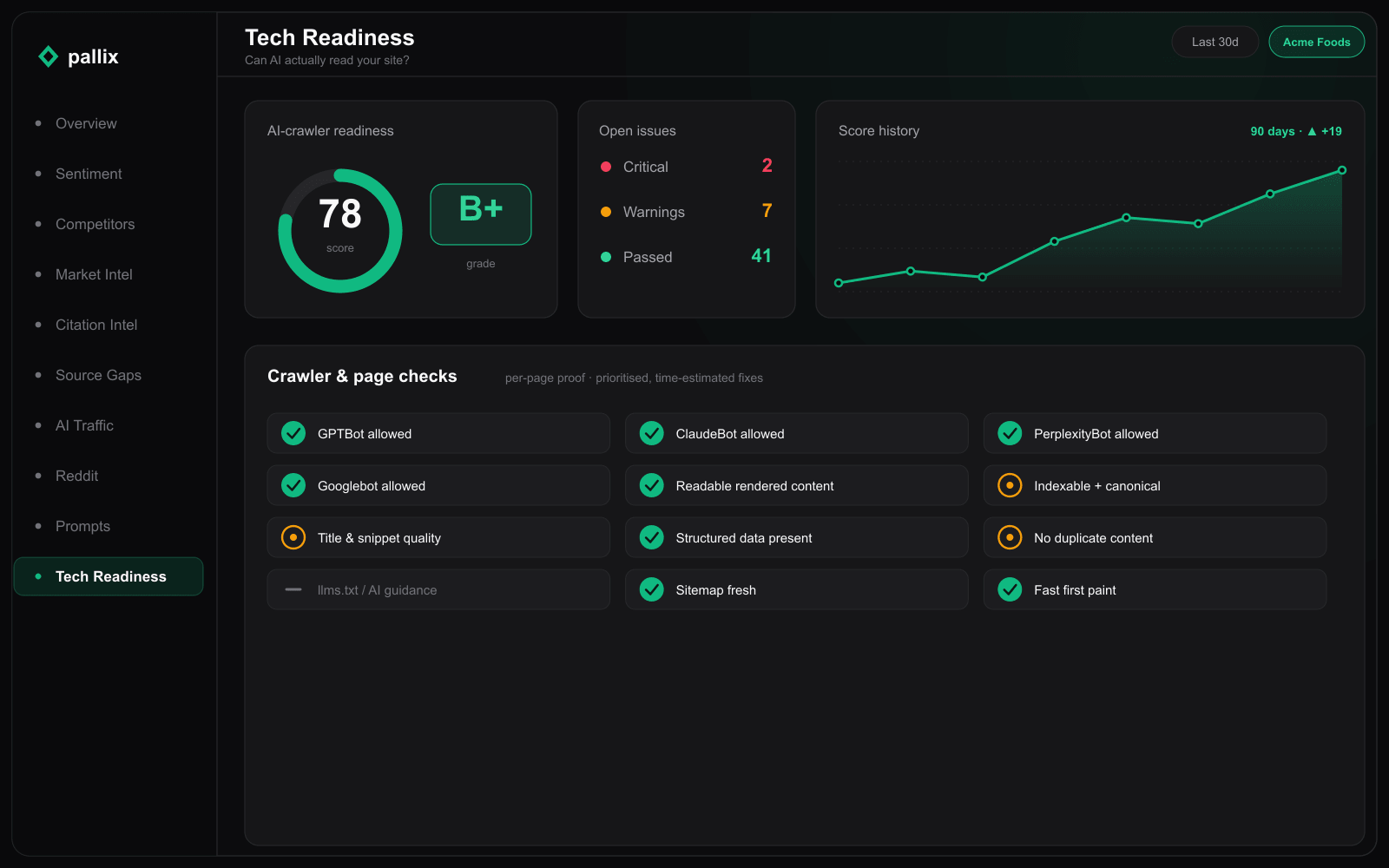
Tech Readiness: making sure AI can read you at all
You can do everything else right and still lose for a dull, mechanical reason: AI literally can't read your site. Thin pages, blocked crawlers, duplicate or missing metadata — any of these can quietly make you uncitable. The intent of Tech Readiness is to catch those problems, framed specifically for how AI systems crawl and interpret pages rather than generic SEO box-ticking.
Pallix checks whether the AI crawlers that matter are actually allowed in, whether your pages return content they can read, whether your titles, snippets, structured data and canonical signals are clean enough to be understood and trusted — and tracks all of it over time so you can see whether your site is getting easier or harder for AI to use. Crucially, it doesn't just grade you; it hands you a prioritised, time-estimated list of the fastest fixes with the clearest payoff, so a thin product page or a missing tag becomes a half-hour task rather than a mystery.
The free audit: see your standing before you commit
You don't have to take any of this on trust. A free Pallix audit runs your brand across the major engines and returns a complete diagnosis: your visibility score and key metrics, your technical readiness, your single best next move, your discovery gaps, why AI picked competitors over you, who it recommends instead, where you already win, how it frames your brand, the sources it's citing, and a prioritised action roadmap. It's a genuine first look at where you stand — and the clearest possible demonstration of how Pallix thinks.
What Pallix really is
Put together, Pallix isn't a vanity score and it isn't a one-time report. It's a continuously refreshed system that tells you whether AI recommends you, explains the human conversations and technical signals behind that verdict, and hands you a ranked, evidence-backed list of what to do about it — with every number openable down to the real thread, comment or run that produced it. Its methodology is India-first, built for the languages, sources and buyer behaviour that global tools miss, while working just as well for brands anywhere.
AI has quietly become a discovery channel as consequential as search once was. The brands that see it first, and earn their place in the sources AI already trusts, will own the answer. That's what Pallix is for.
Frequently asked questions
What is Pallix?
Pallix is an AI visibility platform that tracks how AI assistants like ChatGPT, Perplexity and Google's AI Overviews recommend your brand, explains why, and gives you a prioritised, evidence-backed list of fixes. It is built India-first but works for brands in any market.
What is AI visibility?
AI visibility is how prominently and positively your brand appears when buyers ask AI engines for recommendations in your category. If AI does not name you in its answer you are invisible to that buyer, because there is no “page two” in an AI answer.
How is Pallix different from traditional SEO tools?
Traditional SEO tools measure Google rankings and keywords. Pallix measures whether AI engines name and recommend your brand, and analyses the third-party sources — Reddit, marketplaces, YouTube and editorial coverage — that those engines actually cite, which SEO tools were never built to track.
Which AI engines does Pallix track?
Pallix tracks the major answer engines buyers use, including ChatGPT, Perplexity, Google AI Overviews and Gemini, and lets you scope prompts by engine, language (including Hinglish) and region.
Is Pallix only for Indian brands?
No. Pallix’s methodology is built India-first — Hinglish prompts, Indian sources and Indian buyer behaviour — but the audit and dashboard work for brands in any market, and the same rigour applies globally.
Is there a free version of Pallix?
Yes. A free Pallix audit runs your brand across the major engines and returns your visibility score, technical readiness, competitor gaps, the sources AI cites and a prioritised action roadmap — with no sales call required.
Run a free AI visibility audit at pallix.in.