Pallix vs the field: how AI visibility platforms actually compare in 2026
The AI visibility category has gone from non-existent to crowded in under two years. There are now dozens of tools promising to tell you how ChatGPT, Perplexity and Google's AI Overviews talk about your brand. So the useful question isn't "who exists" — it's "who does what, and how deeply." This is an honest, capability-first comparison of Pallix against the major global and Indian players, judged on what each tool actually does rather than how big it is.
A note on method: we're comparing on depth and approach, not on funding or user counts. A tool with a million users that only shows you a score is less useful to a founder than one that explains the score and tells you how to move it. We've also tried to be fair about where others are genuinely stronger than Pallix — because a comparison you can't trust isn't worth reading.
The landscape, briefly
The global field breaks into a few groups. Profound is the established enterprise leader, serving large clients on enterprise pricing, with a brand index, AI-crawler analytics, marketing agents and SOC 2 Type II compliance aimed at mid-market and enterprise organisations. Peec AI tracks brand performance across a wide range of models and measures three core metrics — visibility, position and sentiment — with prompt-level monitoring. Otterly AI is the most accessible entry point at around $29/month, and AthenaHQ is a Y Combinator-backed platform with a citation engine and GA4/GSC integration. Around them sit Scrunch, Evertune, Bluefish and Writesonic, plus the legacy SEO suites — Semrush and Ahrefs — which have added AI-visibility modules onto their existing platforms. Semrush's AI Visibility Toolkit (bundled with its SEO toolkit as "Semrush One") and Ahrefs' Brand Radar both track mentions, citations and share of voice across the major engines and are genuinely capable at the tracking layer; but they are macro tools priced as add-ons on top of a base subscription, they cover fewer engines than a dedicated tool (Brand Radar, for instance, leaves out Claude, Grok and Meta AI), and the "fix" step routes you back into generic content and social tooling rather than AI-specific action — Semrush's own onboarding notes the optimisation work "often happens manually or with the help of other Semrush toolkits."
In India, the picture is different. Listable Labs, by its own product pages, tracks three engines (ChatGPT, Perplexity and Gemini) and is built around four things: a visibility score, citation tracking, competitor benchmarking, and — its real spine — a content-generation engine that produces 25 to 150 "AI-optimised" articles a month by tier. Its own "Insights → Actions → Impact" framing makes this explicit: the "action" it offers is generating content, and its measurement layer is a GA4/GSC connection that reads your existing analytics. That makes it a narrower, content-mill-led tool than it markets itself as — hallucination detection sits behind a contact-sales enterprise tier, and there is no source-gap targeting, community engine, AI-crawler readiness, or first-party AI-referral attribution of the kind Pallix is built on. GetCito is, by its own description, "both a tool and a consultancy": a free open-source monitoring tool, with paid plans ($599–$999/month) that are essentially a managed GEO service — a human team of strategists, content writers, developers and a community manager who produce content, run backlink and brand-mention outreach, and manage Reddit and Quora on your behalf. It has its own monitoring features (an AI visibility checker, competitor radar and a crawlability check), but the product you actually buy at the paid tiers is done-for-you execution, not self-serve software. Beyond those, much of the Indian market is served by full-service agencies (Infidigit, Techmagnate and others) adding GEO to their offering. In other words, India has a handful of early products and a lot of agencies — which is exactly the gap Pallix was built into.
Pallix's position in this field: India-first, but built to work globally. The audit and dashboard now serve brands in any market, but the methodology is designed around the things global tools handle worst — Hinglish queries, Indian sources, Indian buyer behaviour — which also happens to make it rigorous everywhere.
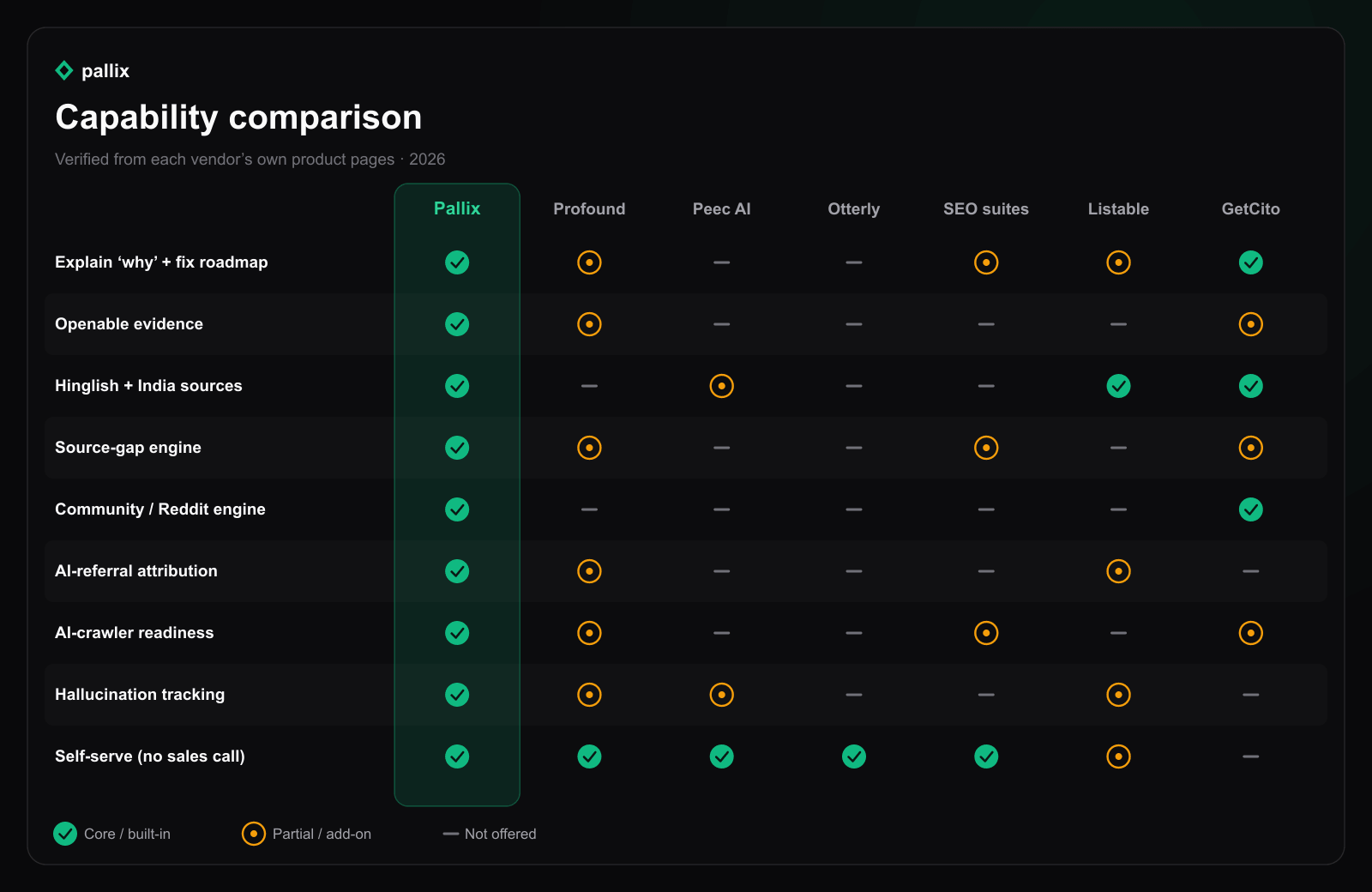
The grid above is the short version; the sections below explain what actually sits behind each row.
Where the real differences are
1. Monitoring vs understanding vs fixing
This is the single biggest divide in the category, and it's a quality difference, not a feature-count one. Most tools are monitoring platforms. As reviewers put it bluntly about the popular monitoring tools: you see the problem, you solve it elsewhere. They show you a visibility score, a share of voice, maybe a sentiment number — and then it's on you to figure out why and what to do.
Pallix is built around the "why" and the "what next." It doesn't stop at telling you that you scored low on a prompt; it shows which competitors were named instead, reads the exact sources the AI used to build that answer, and produces a prioritised roadmap of fixes — down to specific owned pages worth strengthening and the reason each one matters. The enterprise leaders are moving toward action too (Profound has marketing agents; Writesonic has in-platform workflows), but for a lean team, Pallix's explain-and-fix loop is the core of the product rather than an add-on.
2. Evidence you can open, not numbers you have to trust
A score is only as good as the proof behind it. Pallix's design principle is that every number should be openable. Click an at-risk prompt and you see the full run output across models, the competitor citations and the source citations behind it. Click a sentiment aspect like "pricing" and a "view evidence" button pulls the actual community thread or marketplace comment where a real person said it. The brand scorecard, the source gaps, the Reddit opportunities — all of them open to the underlying threads and comments. You're never asked to take a metric on faith. This depth of traceability is unusual; most tools give you the metric and stop.
3. India-first methodology — that travels
Indian buyers ask in Hinglish ("Rs 150 mein kaunse protein milkshake ache hain jo lactose free bhi hain?"), and the sources AI trusts for India sit on Indian platforms — marketplaces, Indian YouTube reviewers, Indian subreddits. Global tools, built for US and European markets, tend to surface US sources and sometimes recommend brands that aren't even sold in India. Pallix runs Hinglish prompts natively and analyses the Indian sources that actually shape Indian buying decisions. Crucially, this isn't a limitation — the same rigour applies to any market, so a brand outside India gets a tool built to take local context seriously rather than assuming everyone shops like an American.
4. A source-level and community engine, not just tracking
Knowing you're invisible is step one; knowing where to go to fix it is the hard part. Pallix's Source Gaps screen ranks the highest-value domains to influence next by source trust, competitor advantage and evidence strength, grouped by play (marketplace, community, rankings) with a winnability score and a recommended fix for each. Its Reddit engine lets you configure communities, keywords and a lookback window, then surfaces the subreddits and topics where your category is being discussed but your brand isn't — with the supporting threads attached. This turns "improve your AI visibility" from a slogan into a specific, prioritised to-do list.
5. AI traffic attribution — counting what others miss
When an AI assistant sends a real person to your website, most analytics tools record it as "direct" because the referrer is stripped. So the traffic AI already drives to you is invisible. Pallix includes a first-party tracker you add to your site that attributes genuine AI-referred human visits and separates them from crawler hits — giving you AI visits, sessions, traffic share, returning-AI visitors and an AI conversion rate. Profound has crawler analytics at the enterprise end; making human AI-referral attribution this central and accessible is a distinctive part of Pallix's approach.
6. Technical readiness, built in
Getting cited isn't only about content — AI has to be able to read your site at all. Pallix's Tech Readiness screen checks whether the core AI crawlers (GPTBot, ClaudeBot, PerplexityBot, Googlebot and more) are allowed, whether pages render readable content, indexability and canonical health, title and snippet quality, duplicate-content signals, structured data and whether an AI-guidance file exists — with per-page proof and a prioritised, time-estimated fix list, tracked over time. Some tools offer a crawler check (the SEO suites and a few others do), but most treat the technical layer as a separate audit; Pallix folds AI-crawler readiness, per-page proof and a prioritised fix list into the same loop as everything else.
7. Hallucination tracking
A confident, wrong answer about your brand can cost a sale as surely as invisibility can. Pallix flags hallucinations as a first-class metric across the Overview and prompt-detail views — surfacing where models are saying untrue things about you so you can correct the underlying sources. It's the kind of trust signal that matters most in regulated or claims-sensitive categories.
8. Built to be usable without an enterprise contract
The category's strongest tools are largely enterprise-priced and procurement-heavy. Profound's plans are custom and aimed at mid-market and enterprise. Pallix is designed so a founder or a lean marketing team can run a free audit and get to value without a sales call — while still being capable enough for larger teams. The difference is accessibility, not a ceiling.
Where competitors are genuinely stronger
A fair comparison has to say this plainly. If you're a large US enterprise, Profound's maturity, scale, compliance posture (SOC 2 Type II) and closed-loop attribution are ahead of a younger product, and that matters for regulated industries and big procurement. Profound has also published the category's only real detection-speed benchmark, which is a genuine research contribution. If you already live inside Semrush or Ahrefs, their bundled AI modules are the path of least resistance — one less tool, one bill — and for light tracking that convenience is worth a lot. If you want the cheapest standalone entry point, Otterly's low price and Semrush integration are hard to beat. If you need the broadest possible model coverage at higher tiers, Peec AI emphasises wide model and country support. And among Indian options, GetCito's managed-service model — a human team that does the work for you — suits brands that would rather outsource execution than run a tool themselves.
Pallix's bet is different: that most brands don't want either a bare monitoring dashboard or a fully outsourced agency, but a tool that shows them exactly what's happening, proves it with real evidence, and tells them precisely what to do — built first for the market global tools understand least.
Choosing well
- Choose Pallix if you want depth over a vanity score: the why behind every result, openable evidence, source- and community-level action, AI-traffic attribution and technical readiness in one loop — with an India-first methodology that also works for global brands, and pricing a founder can actually start on.
- Choose Profound if you're a large enterprise needing maximum scale, compliance and white-glove support.
- Choose Otterly if you want the cheapest entry point or already run Semrush.
- Choose Peec AI if broad model coverage and mid-market analytics are your priority.
- Choose a managed agency like GetCito if you'd rather hand execution to a human team than operate a platform.
The category is real, and it's only going to matter more as buyers keep shifting from searching to asking. The right tool depends on your stage and your market — but if you want to understand and fix how AI recommends you, and you care about getting India right while keeping the door open to the world, that's the gap Pallix is built for.
Frequently asked questions
What is the best AI visibility tool?
It depends on your stage and market. Pallix is strongest for brands that want to understand and fix AI visibility with openable evidence and an India-first methodology; Profound suits large enterprises needing scale and SOC 2 compliance; Otterly is the cheapest entry point; Peec AI emphasises broad model coverage.
How is Pallix different from Profound?
Profound is the enterprise leader with custom, sales-gated pricing aimed at mid-market and large organisations. Pallix offers a comparable explain-and-fix loop with openable evidence, AI-crawler readiness and AI-referral attribution, accessible to founders and lean teams without a sales call and tuned for Indian sources and Hinglish queries.
Is Pallix better than Semrush or Ahrefs for AI visibility?
Semrush and Ahrefs have capable AI-visibility modules, but they are add-ons on top of an SEO subscription, cover fewer engines (Ahrefs’ Brand Radar omits Claude, Grok and Meta AI), and route fixes back into generic content tooling. Pallix is purpose-built for AI visibility with AI-specific, prioritised fixes.
How does Pallix compare to Listable Labs and GetCito in India?
Listable Labs is largely a content-generation engine across three engines, and GetCito is a monitoring tool plus a done-for-you managed GEO service. Pallix is self-serve software focused on explaining and fixing AI visibility, with source-gap targeting, a community engine and first-party AI-referral attribution.
Does Pallix work outside India?
Yes. Pallix is built India-first — the context global tools handle worst — but the same methodology applies to any market, so brands anywhere get rigorous, locally-aware analysis.
Run a free AI visibility audit at pallix.in.