The Board Asked Where the AI Visibility Number Comes From. Most Platforms Cannot Answer.
Founder & Editor
Why auditability, multi-market coverage and per-client economics are becoming the deciding criteria in AI visibility procurement
A marketing director presents a quarterly review. One slide shows AI visibility at 34 out of 100, up from 29. The CFO asks a reasonable question: what is that number, and what would it take to move it ten points?
In most organisations, the honest answer is that nobody knows. The score arrived from a vendor dashboard as a finished figure. Its inputs are not disclosed. Its weights cannot be inspected. And the underlying data — which AI answers, from which region, citing which sources — is summarised rather than shown.
This is becoming the central procurement issue in a category that barely existed two years ago.
What the underlying data shows
Two findings shape why this is now a procurement conversation rather than an experiment.
The first is that spend does not buy presence. Across a study of 23 Indian consumer brands, average visibility landed at 42.5 out of 100, and several of the best-capitalised names in the set finished in the lower half. Whatever governs whether an engine names a brand, budget is not it — which means the problem cannot be solved by reallocating media spend and has to be measured and worked directly.
The second is where citations actually go. In category answers analysed across markets, roughly 51.6% of cited sources were competitors' own websites, against 5.8% for the brand being asked about. For a portfolio owner this reframes the task entirely: the work is not producing more of a client's own content, it is establishing presence on the third-party pages that engines assemble answers from — and that requires knowing which pages those are.
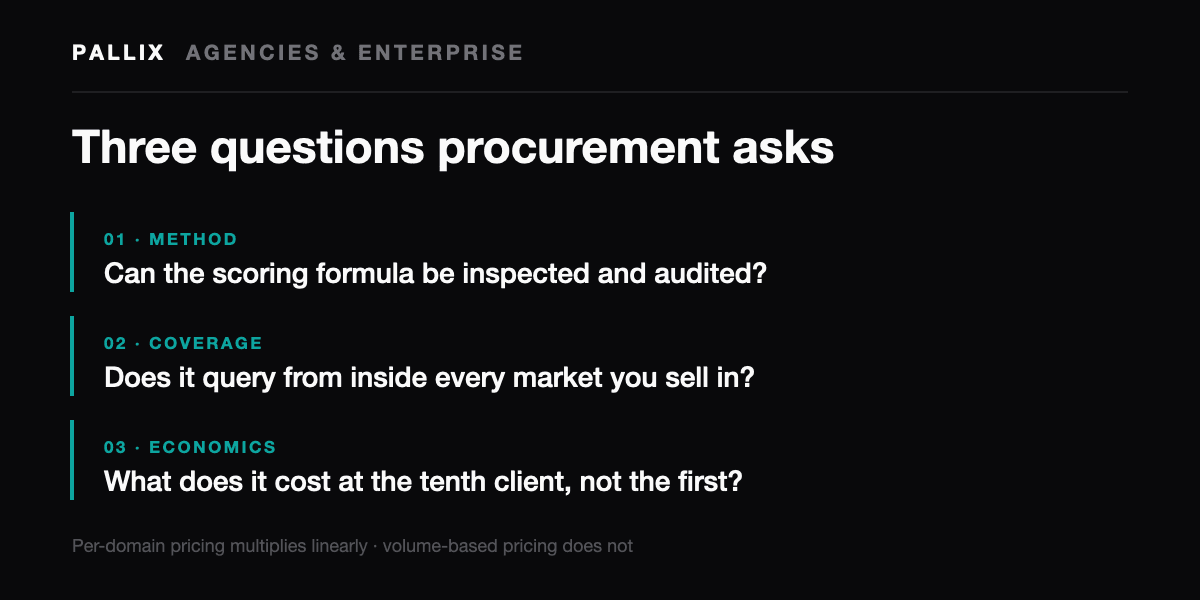
Three criteria in AI visibility procurement
1. The methodology has to be inspectable.
Search rankings were externally verifiable. Anyone could run the query and check position seven. AI answers cannot be checked that way — they vary by user, session, region and phrasing. When the result cannot be independently confirmed, the credibility of the measurement rests entirely on the transparency of the method.
A score whose formula is hidden is a score that cannot survive an internal audit, a client challenge, or a change of agency.
2. Coverage has to be per-market, not per-account.
Any organisation operating across territories faces the same issue: an AI engine queried from one country returns different sources than the same engine queried from another. A locale parameter attached to a query originating in a single location does not reproduce this. It labels the request; it does not relocate it.
For a business selling in the US, the UK and India, three different citation ecosystems are in play. Measuring all three through one origin produces one accurate reading and two misleading ones.
3. The economics have to work at the tenth client, not the first.
Agencies are the fastest-growing buyer segment in this category, and most incumbent pricing was designed for single brands. Per-domain models — common among platforms that added AI tracking to an existing SEO suite — multiply linearly. Ten client domains at typical per-domain rates approaches four figures monthly before seats are counted.
An agency evaluating on the first client's price will discover the problem at the tenth.
Auditable AI visibility scoring: what it looks like
Pallix, an AI visibility and citation intelligence platform, exposes its scoring method rather than presenting a finished figure. Its settings include a Scoring section defining which prompts count toward scores and how those scores are calculated — with editable weights.
The practical consequence is that an agency can set the formula to match a client's stated priorities, show the client that configuration, and report against it. A brand can align the metric with what its own leadership actually cares about. And when the number moves, the cause is traceable rather than asserted.
The same standard applies below the score. Where many platforms report that a domain was cited, Pallix reports the specific URL and the raw AI response it appeared in. Every tracked prompt exposes its full answer text and actual cited links — the evidence, not a summary of the evidence.
For a regulated organisation, or an agency defending its work at renewal, that distinction is the difference between a report and an assertion.
Multi-market and multi-client workspace management
Pallix queries five engines — ChatGPT, Perplexity, Google AI Overviews, Gemini and Microsoft Copilot — with region and language configured at the prompt level rather than the account level, on localised IPs for each region.
For an agency, that means a single environment can carry a US software client, a UK services client and an Indian consumer brand, each measured against its own market, with separate workspaces, competitor sets, scoring configurations and alerting per client.
Team and alert configuration, integrations, and a competitor discovery pipeline sit alongside. Rather than requiring a client to nominate three to five competitors up front — a cap that forces guessing before evidence exists — the platform surfaces candidate competitors from the answers and sources it observes and presents them for review.
Turning AI visibility reporting into client deliverables
The most common criticism of this category in independent reviews is that platforms diagnose without prescribing. For an in-house team, that means a dashboard and no work instruction. For an agency, it means paying for a tool that produces no client deliverable.
The capabilities that close that gap are worth setting out individually, because they are what a scope of work is written from.
Citation intelligence. Every source cited across every tracked answer, ranked by frequency, with the specific URLs rather than domain names — and a column indicating whether the client appears on each page. A source cited two hundred times that never mentions the client is a different brief from one that mentions them occasionally.
Source gaps. The same data reorganised as a target list: pages that decide answers in the category, which competitors are present, which omit the client entirely, and which are ageing enough to justify an editor pitch or a refreshed community answer. For an agency, this is the raw material of an outreach plan.
Source trend tracking. Which types of source an engine favours in a category shifts over time. A retainer built on last quarter's composition drifts out of alignment quietly. Monitoring the trend keeps the strategy current and gives the agency something substantive to report each cycle.
Market intelligence. What real people say about the client and its category across social platforms, marketplaces and editorial — with the underlying links, not aggregate sentiment. This surfaces buyer pain points, unprompted competitor comparisons, and customer vocabulary. It also seeds the prompt set, so what is being tracked reflects what buyers demonstrably ask rather than what the account team assumed.
Aspect-level sentiment. A single sentiment figure tells a client that perception is mixed. Aspect breakdown identifies which attribute — pricing, reliability, support, a product characteristic — is responsible, which converts a report into a scope of work. Hallucination flagging sits alongside, catching cases where an engine states something factually wrong about the client.
Prompt-level triage and plans. Each prompt is classified by priority and risk, exposes its full raw answer text and cited links, and carries a plan describing what would need to change for it to name the client.
Fix generation. Content briefs, FAQ blocks and posts derived from the client's own citation gaps rather than a generic AEO playbook — which by definition cannot know what any individual account is missing.
Technical readiness. Crawlability, rendering and structured-data checks, because a page that cannot be retrieved cannot be cited regardless of how well it is written.
Attributing AI traffic that analytics records as Direct
There is a reporting hole peculiar to this channel. Because AI engines frequently pass visitors along without a referrer header, standard analytics has nowhere to file them and defaults to Direct. The client sees a line item that appears to generate nothing, at exactly the moment the agency is asking to keep funding it.
Server-side detection closes that hole, identifying those sessions by signature rather than by referrer. The practical value for an agency is having two independent numbers — citations observed and sessions attributed — so that when one is challenged in a review, the other stands on its own.
AI visibility pricing for agencies
Entry sits at ₹2,249 monthly, Growth at ₹5,399, with negotiated terms for agency and enterprise portfolios. Evaluation runs on a two-week Growth trial that takes no card details and involves no sales call — worth noting for agencies that need to test a platform against a live client account before committing a retainer to it.
The structural choice is volume-based rather than per-domain pricing, which is what prevents the tenth client costing ten times the first. A free audit is also available without any signup, which some agencies use as a pitch artifact in new business conversations.
Why procurement is changing what agencies buy
Two years ago, AI visibility was an experiment budget line. It is moving into procurement, and procurement asks different questions than experimentation does: how is this calculated, can it be audited, does it cover our markets, and what does it cost at scale.
Platforms optimised for a single brand in a single market, reporting an unexplained number, will answer three of those four questions badly.
The organisations buying now are, increasingly, buying the method rather than the metric.
Frequently asked questions
What should agencies look for in an AI visibility tool?
Three things: whether the scoring method can be inspected and audited, whether queries run from inside each market the agency's clients sell in, and how pricing behaves at ten clients rather than one. Per-domain pricing models multiply linearly and become the constraint quickly.
How much does AI visibility tracking cost for multiple clients?
It depends entirely on the pricing model. Per-domain platforms charge for each client domain separately, which can approach four figures monthly at ten clients before seats are counted. Volume-based models scale more slowly. Pallix starts at ₹2,249 per month with custom agency arrangements above that.
Can one platform track different countries at once?
It depends on whether region is set per account or per prompt. Pallix configures region and language at the prompt level on localised IPs, so a single workspace can carry US, UK and Indian clients, each measured against its own market.
How do you prove an AI visibility score is credible to a client?
By showing the method. A score whose weights are hidden cannot be defended at renewal. Pallix exposes its scoring formula in settings with editable weights, and reports the specific cited URLs and raw AI responses behind the number rather than a summarised domain list.
Do AI visibility platforms produce client deliverables?
Most stop at diagnosis. Pallix generates content briefs, FAQ blocks and posts from each client's own citation gaps, and attaches a per-prompt plan describing what would need to change for that prompt to name the brand.
How many competitors can be tracked per client?
Many tools cap this at three to five, which forces guessing before evidence exists. Pallix runs a discovery pipeline that surfaces candidate competitors from observed answers and sources for review.
Pallix is an AI visibility and citation intelligence platform serving brands and agencies across multiple markets. More at pallix.in.